DocumentsCorrespondenceJul 25, 2023Pages 14–16
Letter: RCMP Annual Performance Plan (APP) — West Shore RCMP (Supt. Todd Preston)
Correspondence from Supt. Todd Preston of the West Shore RCMP to Langford Council (dated 2023-07-10) explaining the Annual Performance Plan (APP), the role of community input in setting priorities, and examples of topics to consider.
Key facts
- Letter date: 2023-07-10
- Author: Supt. Todd Preston, Officer in Charge, West Shore RCMP
- RCMP detachment address: 698 Atkins Avenue, Victoria, BC V9B 3A4
- Recipient: Langford Council, 2nd floor, 877 Goldstream Avenue, Langford, BC V9B 2X8
- Content: describes APP purpose, need for community consultation to inform policing priorities, and how local concerns feed into the APP
Royal Canadian Mounted Police
Supt. Todd Preston
Officer in Charge
West Shore RCMP Detachment
698 Atkins Avenue
Victoria, BC V9B 3A4
Langford Council
2nd floor, 877 Goldstream Avenue
Langford, BC
V9B 2X8
Date: 2023-07-10
RE: RCMP Annual Performance Plan (APP)
Dear Langford Council,
The RCMP Annual Performance Plan (APP) is utilized to plan and support informed strategic decision making to ensure consistent and effective management in achieving organizational objectives and priorities. In short, each community we work in and with is a unique collection of people, problems, issues and solutions. In collaboration with our communities we use this plan to yearly adapt and strengthen our Policing responses to specific challenges.
While one community may look similar to another, the people of each community may not see the problems and solutions as the other does. This tool allows us to confirm through local Governments and Counsels, five (5) or six (6) specific areas they want police resources to focus on. This targeted and tailored approach will produce more specific results in those areas while still allowing us to continue to tackle other non-specified ones.
The true power of the tool is the community's constituents and what they say is important and a priority to them. This is not something that the RCMP can decide for each community but we can use this information to create a comprehensive and effective plan. You can learn this by speaking with randomly or targeted people in your community, questions that come up at Town Halls or Counsel Meetings, walk in or mailed in questions/ concerns at your Constituents Offices, input from partners within your communities such as school, recreational avenues, business centres, homeowners/ renters, First Nation communities, visitors to your communities, etc.
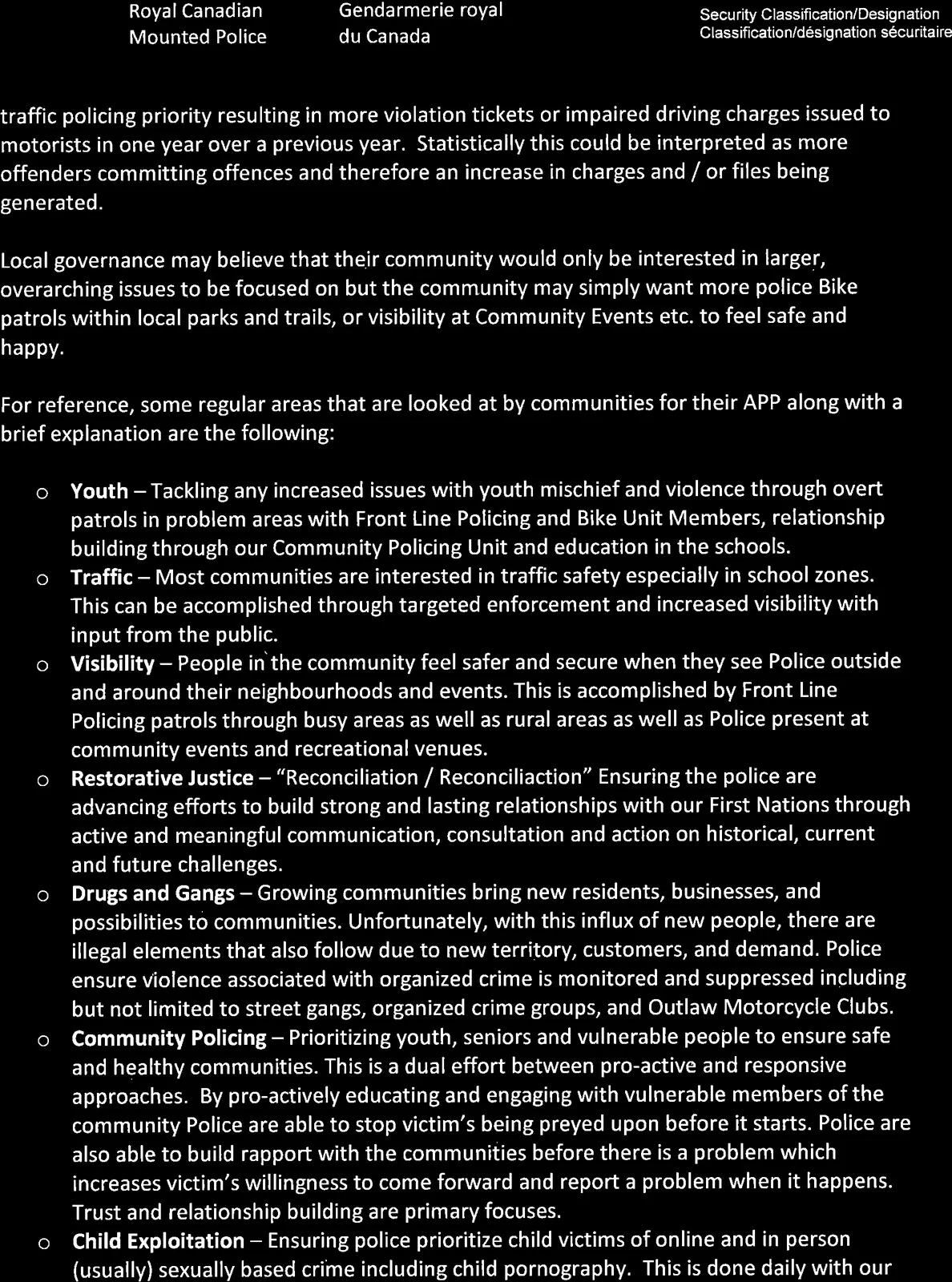
Yearly statistics only do not show what your community constituents are most concerned about and want police resources focused on. For instance, a statistical increase of charges against offenders could have resulted because of targeted enforcement the previous year. Such as a traffic policing priority resulting in more violation tickets or impaired driving charges issued to motorists in one year over a previous year. Statistically this could be interpreted as more offenders committing offences and therefore an increase in charges and / or files being generated.
Local governance may believe that their community would only be interested in larger, overarching issues to be focused on but the community may simply want more police Bike patrols within local parks and trails, or visibility at Community Events etc. to feel safe and happy.
For reference, some regular areas that are looked at by communities for their APP along with a brief explanation are the following:
- Youth – Tackling any increased issues with youth mischief and violence through overt patrols in problem areas with Front Line Policing and Bike Unit Members, relationship building through our Community Policing Unit and education in the schools.
- Traffic – Most communities are interested in traffic safety especially in school zones. This can be accomplished through targeted enforcement and increased visibility with input from the public.
- Visibility – People in the community feel safer and secure when they see Police outside and around their neighbourhoods and events. This is accomplished by Front Line Policing patrols through busy areas as well as rural areas as well as Police present at community events and recreational venues.
- Restorative Justice – “Reconciliation / Reconciliaction” Ensuring the police are advancing efforts to build strong and lasting relationships with our First Nations through active and meaningful communication, consultation and action on historical, current and future challenges.
- Drugs and Gangs – Growing communities bring new residents, businesses, and possibilities to communities. Unfortunately, with this influx of new people, there are illegal elements that also follow due to new territory, customers, and demand. Police ensure violence associated with organized crime is monitored and suppressed including but not limited to street gangs, organized crime groups, and Outlaw Motorcycle Clubs.
- Community Policing – Prioritizing youth, seniors and vulnerable people to ensure safe and healthy communities. This is a dual effort between pro-active and responsive approaches. By pro-actively educating and engaging with vulnerable members of the community Police are able to stop victim’s being preyed upon before it starts. Police are also able to build rapport with the communities before there is a problem which increases victim’s willingness to come forward and report a problem when it happens. Trust and relationship building are primary focuses.
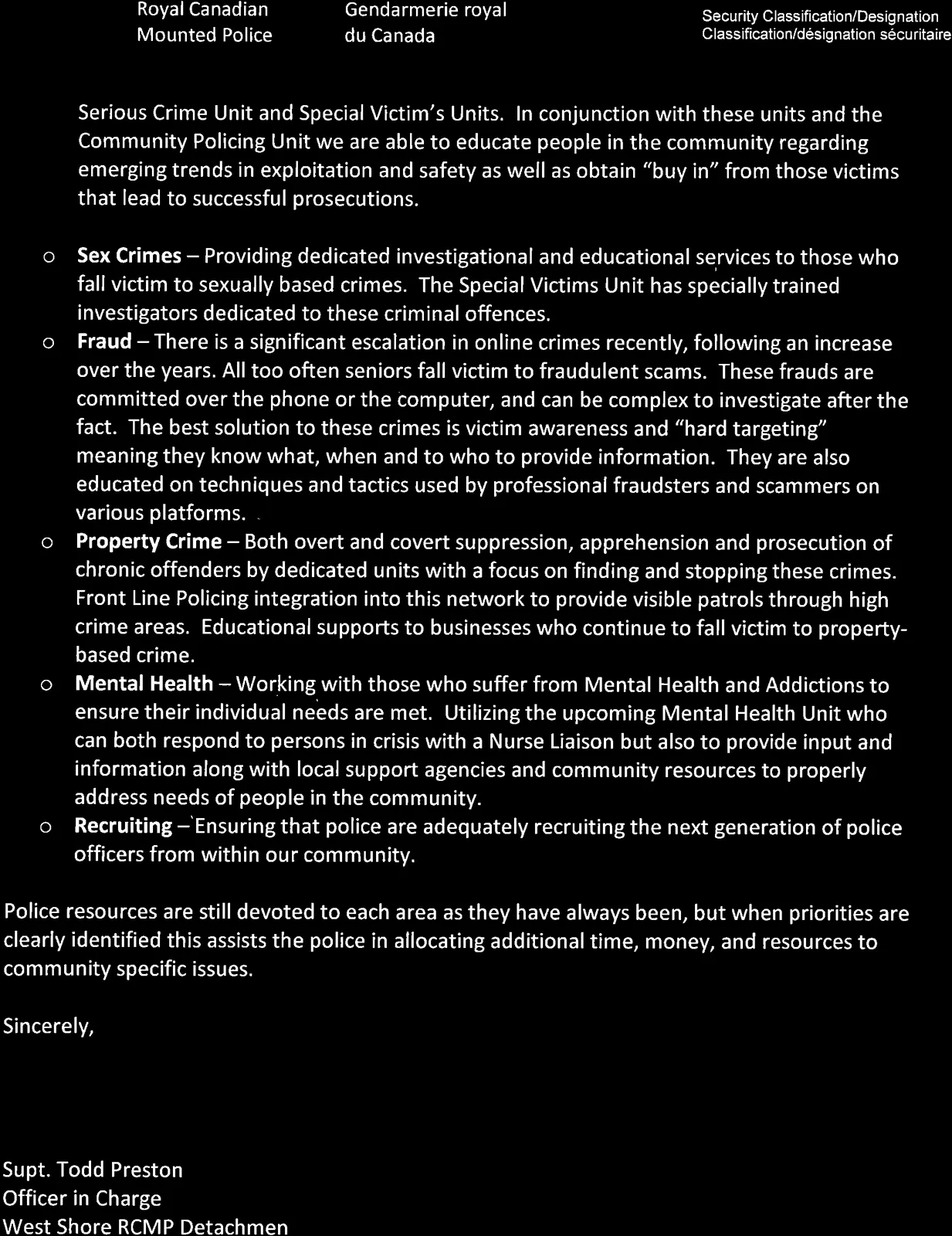
- Child Exploitation – Ensuring police prioritize child victims of online and in person (usually) sexually based crime including child pornography. This is done daily with our Serious Crime Unit and Special Victim’s Units. In conjunction with these units and the Community Policing Unit we are able to educate people in the community regarding emerging trends in exploitation and safety as well as obtain “buy in” from those victims that lead to successful prosecutions.
- Sex Crimes – Providing dedicated investigational and educational services to those who fall victim to sexually based crimes. The Special Victims Unit has specially trained investigators dedicated to these criminal offences.
- Fraud – There is a significant escalation in online crimes recently, following an increase over the years. All too often seniors fall victim to fraudulent scams. These frauds are committed over the phone or the computer, and can be complex to investigate after the fact. The best solution to these crimes is victim awareness and “hard targeting” meaning they know what, when and to who to provide information. They are also educated on techniques and tactics used by professional fraudsters and scammers on various platforms.
- Property Crime – Both overt and covert suppression, apprehension and prosecution of chronic offenders by dedicated units with a focus on finding and stopping these crimes. Front Line Policing integration into this network to provide visible patrols through high crime areas. Educational supports to businesses who continue to fall victim to property-based crime.
- Mental Health – Working with those who suffer from Mental Health and Addictions to ensure their individual needs are met. Utilizing the upcoming Mental Health Unit who can both respond to persons in crisis with a Nurse Liaison but also to provide input and information along with local support agencies and community resources to properly address needs of people in the community.
- Recruiting – Ensuring that police are adequately recruiting the next generation of police officers from within our community.
Police resources are still devoted to each area as they have always been, but when priorities are clearly identified this assists the police in allocating additional time, money, and resources to community specific issues.
Sincerely,
Supt. Todd Preston
Officer in Charge
West Shore RCMP Detachment
Document Images
(6)