DocumentsAppendixAug 21, 2023Pages 41–52
CRD Transportation Governance Workbook — Introduction and Background
The CRD workbook introduction and background describing regional transportation challenges (congestion, mode-shift, GHG emissions), current roles, the Regional Transportation Plan, governance considerations and the three-level governance framework to explore (consolidated CRD service, expanded CRD authority, new authority).
Key facts
- Workbook cover: 'Capital Regional District Transportation Governance Engagement Workbook July 2023'
- Three core challenges identified: congestion, mode-shift, greenhouse gas emissions
- Regional mode share baseline: 26.6% walking/cycling/transit; regional objective: 45% active transportation + transit (from glossary)
- Governance steps referenced: 2014 Transportation Service Feasibility Study recommended stepwise transition
- Engagement scope: test support for regional decision-making trade-offs; identify preferences on funding, planning, policy and service delivery; explore opportunities and constraints
Capital Regional District
Transportation Governance Engagement Workbook
July 2023
Introduction
The Capital Region District (CRD) is engaging member municipalities, electoral areas and partner agencies over the summer and fall of 2023 to solicit feedback on regional transportation governance. First Nations will be invited to participate.
The purpose of this workbook is to provide CAOs, senior staff and elected officials with the information they will need to provide input on potential changes that will help achieve our shared transportation mode share and greenhouse gas reduction targets.
Once you have read through the information, please complete the questionnaire and pass a council resolution to endorse your response. The completed workbook with council resolution is to be returned by Friday September 29, 2023.
Municipalities, electoral areas and partner agencies in our region are responsible for submitting one questionnaire each.
CRD staff will consolidate your feedback and report back to the CRD Board in November 2023.
Background
There are three core challenges affecting transportation in our region:
Congestion
Leads to increased travel time and decreased quality of life for residents, especially during peak periods.Mode-shift
As the regional road network is already built out, implementing infrastructure solutions will be challenging due to cost and geography. To address this, shifting mode share and exploring alternative transportation options are necessary.GHG Emissions
The transportation sector accounts for 40% of the region's greenhouse gas (GHG) emissions. Reducing these emissions requires urgent action.
Transportation is a critical issue
In response to these challenges, the CRD Board identified transportation as a strategic priority for the 2023-2026 term and directed staff to investigate governance options and expedite implementation. The CRD Board also approved transportation priority implementation strategies, focusing on areas such as active transportation, RapidBus implementation, highway safety and multi-modal improvements, connectivity to Salt Spring Island and the Southern Gulf Islands and improving access to local transit service in rural areas, among others.
Current transportation planning
Local governments, BC Transit and the Province each have different responsibilities for planning, developing, operating and maintaining roads and pedestrian and cycling infrastructure. The current role of the CRD is limited to planning and policy support, working with partners to advance actions in the Regional Transportation Plan (RTP). The CRD also operates regional trails. The RTP sets out the Regional Multi-modal Network (Figure 1) and provides policy direction and actions. The CRD identified 12 regional priorities to further support implementation.
The CRD Board set expectations for transportation improvements in the region by unanimously approving the regional transportation priorities. Staff have advised what can be done within the current structure through CRD, local government and partner agency work plans, the Transportation Working Group and the CRD Transportation Committee. To achieve regional aspirations, the CRD Board has given direction to investigate and expedite the consideration of governance changes.
The CRD Board will use your responses to the questionnaire in this workbook to determine the level of change that can be achieved over this term and, pending support, define regional aspirations over the long-term.
Additional background
Additional background can be found in the following:
- 2014 Regional Transportation Plan and Executive Summary
- 2021 RTP Report Card
- 2014 Transportation Service Feasibility Study
- 2011 Pedestrian and Cycling Master Plan and Executive Summary
- Transportation Priority Areas
- Transportation Priority Area Implementation Strategies
- 2023-2026 Board Priorities
- 2023 Transportation Governance Jurisdictional Scan Resources
Figure 1: Regional Multi-modal Network Reference Map (2023)
What is transportation governance?
Transportation governance is about decision-making. A governance structure sets out how decisions are made, who is involved, who pays and who is accountable for implementation. Our current transportation governance framework is mode-specific and set out in legislation. This means that there are multiple decision-makers, which limits integrated multi-modal decision‑making and leads to competition for limited funds.
To achieve our regional mobility objectives, we must change how we make decisions and fund transportation. With your support, we can work together to create a long-term cohesive approach to transportation governance in our region.
Along the spectrum of transportation governance, one level involves an authority. In general, a regional transportation authority is a governing body responsible for planning, coordinating and implementing transportation strategies and projects.
Regional transportation authorities typically operate within a particular geographical area, such as a metropolitan area or a group of municipalities. They work collaboratively with local governments, transit agencies and other stakeholders to develop integrated regional transportation plans and policies. The authority's role may vary depending on the governance model in place. For example, in British Columbia, the Province regulates transit through the British Columbia Transit Act and created the transportation authority TransLink through legislation.
If done effectively, a regional transportation authority can ease and support the transportation management and delivery burden on municipalities. This allows them to focus on other priorities important to their residents. The ultimate goal of a regional transportation authority is to improve mobility region‑wide, which cannot be achieved through better coordination or governance changes alone.
Transportation governance considers three main dimensions:
- Level of multi-modal integration
- Decision-making authority
- Funding
To implement an authority, the region's municipalities, electoral areas and partner agencies would need to reach consensus on:
- Modes subject to the authority
- Desired service level for each mode
- Funding model
- Reporting relationship between the new authority and existing decision-makers
Governance potential
In 2014, the CRD commissioned a Transportation Service Feasibility Study which recommended transitioning to a multi-modal governance framework in a stepwise fashion, with each step proving its feasibility before moving to the next. Informed by the feasibility study, the CRD is exploring three potential levels of change in governance, each offering unique opportunities and considerations.
These steps aim to ensure that the Regional Multi-modal Network seamlessly integrates major roads, trails and connections with local and provincial networks and centres.
The three governance levels below must be developed collaboratively. Each level can operate as a standalone model or build upon the successes and feasibility demonstrated in the previous step, ensuring a carefully considered and adaptable transition toward a desired multi‑modal future. This approach allows us to evaluate and refine our strategies, ensure that decisions are evidence-based and confirm that each step is viable and effective before moving on to the next.
Your responses to this questionnaire will be used to turn these levels from concepts into governance options. Once the options are developed, CRD staff will be able to identify impacts and you will have another opportunity to provide feedback.
Level 1 — New CRD Service: Consolidating Transportation Functions
The first step in our proposed governance framework involves consolidating the existing CRD regional transportation planning function with the active transportation function of regional trails into a single service.
This new service would enable streamlined service-level changes and enhance coordination and decision‑making processes.
By centralizing responsibilities, we can lay the foundation for a more integrated and efficient transportation system within the capital region.
Level 2 — Expanding CRD Authority: Empowering Change and Funding
Building upon the consolidated department, the second level of our governance model focuses on expanding the authority of the CRD.
This expansion would grant the CRD new funding mechanisms and service authorities to drive transformative changes in travel behavior and advance the development of a robust multi‑modal network.
With the ability to hold property, raise and distribute funds and offer targeted programs, the CRD would have greater flexibility and resources to implement innovative transportation solutions that meet the diverse needs of our region.
Level 3 — New Authority: Streamlined Decision-Making and Investment
As we progress further along our path, the third level of our governance model envisions the establishment of a new regional transportation authority. Under this model, a single organization would be entrusted with making decisions regarding service levels and investments in the network.
This comprehensive scope and scale of change would require new legislative authority, marking a significant milestone in our journey toward a fully integrated and sustainable regional transportation system.
By centralizing decision-making processes, we can foster greater coordination, efficiency and accountability.
Examples of transportation governance models
The CRD shares many of the same transportation goals as other metropolitan regions: ease congestion during peak travel times, reduce emissions and support higher rates of walking, cycling and transit use. Similarly, the CRD is one of many jurisdictions trying to integrate different transportation modes into a single planning framework, ensure the proper authorities are in place and find dedicated funding to meet service levels.
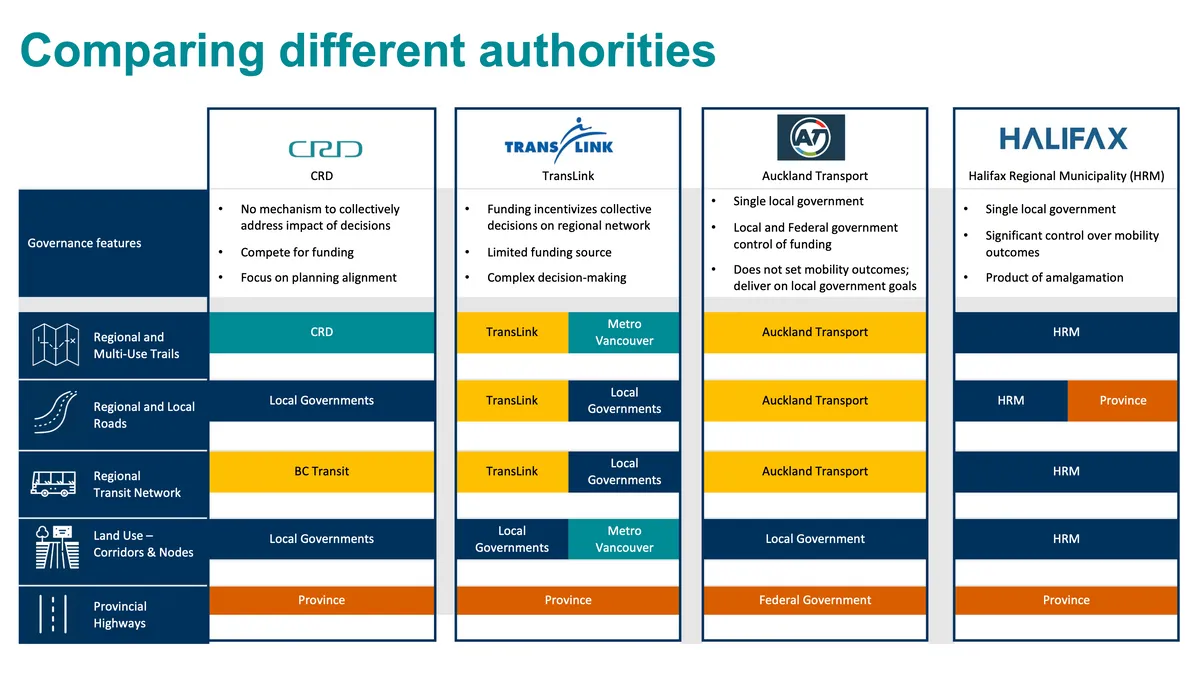
Staff conducted a jurisdictional scan comparing three regional examples of different transportation governance models: TransLink (Metro Vancouver), Auckland Transport (Auckland, New Zealand) and Halifax Regional Municipality (Halifax, Nova Scotia). Each jurisdiction has undergone transformative change and represents archetypes of governance models, combining the three dimensions of transportation governance in different ways as shown in Figure 3 below.
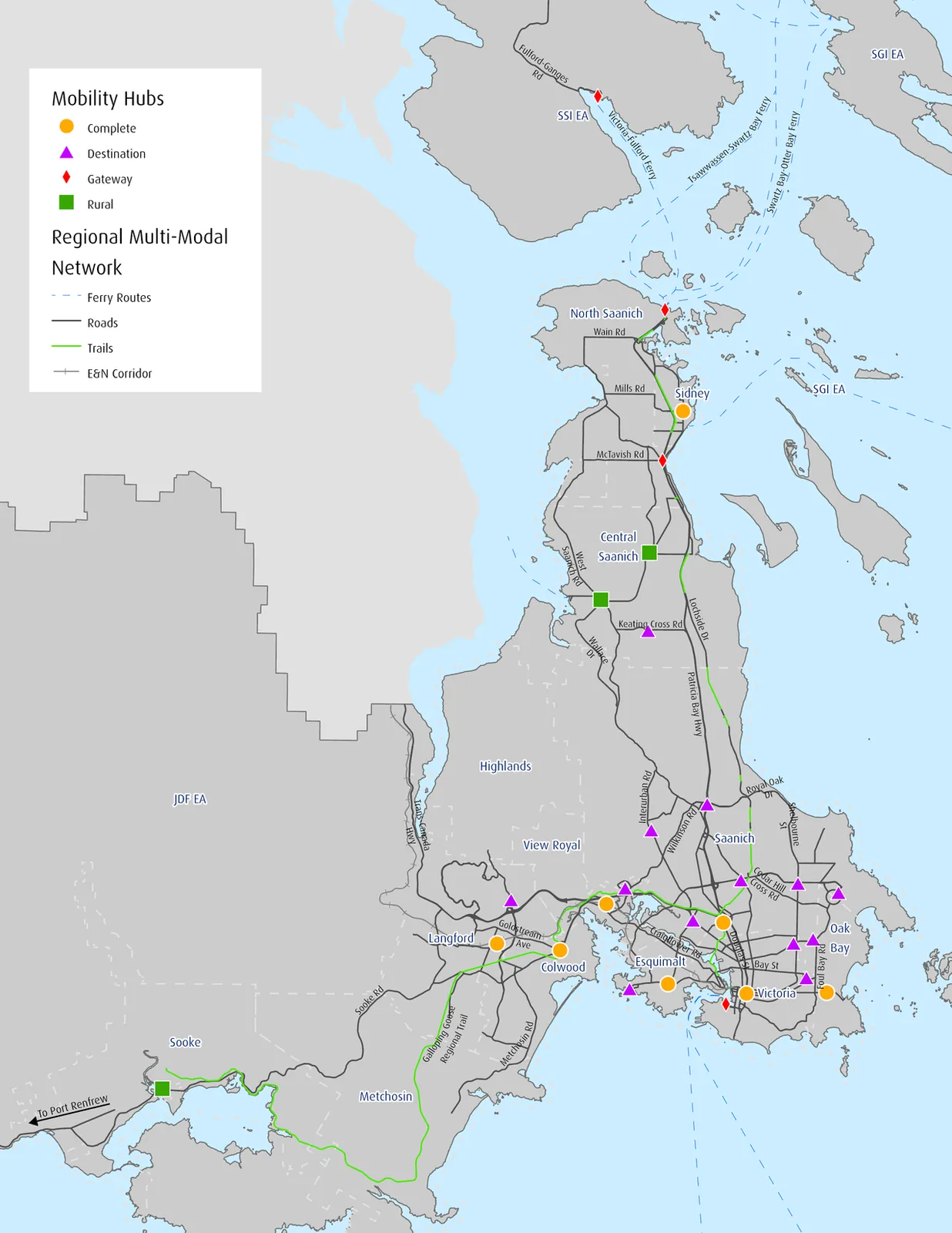
Figure 3: Comparison of transportation governance models
Three key findings from the jurisdictional scan
Another level of government created the transportation authorities to improve mobility.
The CRD, municipalities, electoral areas and partner agencies must provide a strong business case for change, particularly about transit, to ask the Province for new powers.It takes time to become fully operational.
Each transportation authority required over a decade for planning and consolidation to take full effect. This confirms a core assumption from the 2014 CRD Transportation Service Feasibility Study: implementation will happen incrementally, likely following a phased approach (Figure 4).Success is built from a solid base.
Transportation authorities with the tools necessary to decide on mode integration, land use and funding have greater control over mobility outcomes.
Timeline
Figure 4: Transportation governance long-term timeline
Summer 2023
Engagement
Engage 13 local governments, three electoral areas and partner agencies to seek inputFall 2023
Analysis & reporting
Analyse level of consensus for change, report back to the Board and seek Board directionFall 2023
Initiate service feasibility
Pending direction, develop a service feasibility study to deliver on the change that is needed2024
Service establishment
Pending direction, undertake service approval and enact a service establishment bylaw2025-ongoing
Implementation & delivery
Implement required internal changes to increase service levels and prove feasibility2025-2026
Business case for an authority
Pending support, begin building a business case for a new authority2026-on
Delivery
Advocate for legislative change and implement new authority
What we aim to accomplish
- Identify key trade-offs, challenges and opportunities in regional transportation governance.
- Determine the level of support for change and the need for additional tools and resources to advance regional transportation priorities.
- Strengthen collaboration, communication and partnership between member municipalities, electoral areas, partner agencies and the CRD.
- Understand your thoughts and expectations regarding the potential establishment of a regional transportation authority.
We want to hear from you
We recognize the critical role transportation plays in our daily lives, impacting everything from quality of life to economic prosperity and environmental sustainability. A change in regional transportation governance represents a significant opportunity for us to work collectively, transcend boundaries and create a system that supports sustainable mobility, economic growth and community well‑being.
Your perspectives, experiences and aspirations are integral to shaping the future of transportation in our region. Inclusive and collaborative decision-making is critical to developing a system that meets the diverse needs of our residents, businesses and visitors.
By participating in this engagement, you are contributing your insights, sharing concerns and helping co-create a transportation authority that represents the interests and priorities of our member municipalities, electoral areas and partner agencies.
Instructions
How to complete the questionnaire
While you can work from multiple copies, we ask that you submit one completed questionnaire in the electronic form-fillable PDF and one council resolution to endorse your response. Please do not submit a scanned copy of the PDF.
Please submit the completed questionnaire and council resolution to Alesha Hayes with CRD Regional and Strategic Planning at ahayes@crd.bc.ca by Friday September 29, 2023.
All feedback will be carefully considered in the development of a regional governance framework.
When completing the questionnaire, please consider the following:
- A glossary is included in the workbook to provide definitions for terms and concepts used in the questionnaire.
- At your request, CRD staff are available to provide a presentation on transportation governance, including additional background context and regional transportation priorities.
- Your responses will be used to develop governance options for the CRD Board's consideration.
- This is the first step to gather information about transportation governance in our region. There will be further opportunities for engagement and input through 2024.
The questionnaire is a form-fillable PDF. It has been designed to provide organizations with the flexibility to:
- Use it as a collaborative working document that can be shared as you prepare your responses.
- Be completed so that it can be attached as an agenda item.
- Be submitted so that results can be extracted and analysed.
If you have any questions, please contact:
Emily Sinclair, Senior Manager, Regional and Strategic Planning
T: 250-360-3244
E: esinclair@crd.bc.ca

Document Images
(1)