DocumentsStaff ReportAug 19, 2024Pages 201–204
Staff Report: Designated Parking Areas for Shared Micromobility Devices
Report proposing designated parking areas for shared micromobility devices (e-scooters, bikes) and associated policy/implementation considerations.
Key facts
- Listed as Report 10.1 in the agenda (starts page 201)
- Relates to establishing designated parking areas and operational considerations for shared micromobility devices
Staff Report: Designated Parking Areas for Shared Micromobility Devices
t 250.478.7882
e administration@langford.ca
2nd Floor, 877 Goldstream Avenue
Langford, BC V9B 2X8
DATE: Monday, August 19, 2024
DEPARTMENT: Engineering
EXECUTIVE SUMMARY
The purpose of this report is to inform Council of options that would allow staff to approve and enforce designated parking areas for shared micromobility devices within the road right-of-way or other City owned lands. Council supported the use of micromobility devices within public roadways by providing consent to join the renewal of the Provincial Electric Kick Pilot Project starting on April 5th, 2024, for the 4-year term.
Having shared micromobility devices available in key locations throughout Langford could potentially make Langford’s participation in the provincial pilot project more successful, by providing more access to micromobility devices, and more data to better inform future micromobility decisions. This could also spark a regional uptake in shared micromobility options throughout the CRD, if other municipalities were to follow suit.
Among other benefits, app-based micromobility services have evolved to include geo-fence designated parking areas with minimal physical infrastructure (also known as parking corrals). Geo-fencing uses cellphone GPS to only allow for pick-up and drop-off of the micromobility devices in specific areas, with the flexibility to adjust locations based on demand. Staff are now seeking direction from Council on how to proceed with permitting or licencing approved parking corral areas in key public places to interested micromobility service providers.
BACKGROUND
E-Kick Scooters in the CRD
The Provincial Electric Kick Scooter Pilot Project started in 2021, allowing citizens in participating communities to use electric kick scooters (“e-scooters”) within public roadways. Unfortunately, no local governments within the South Vancouver Island Capital Regional District (CRD) chose to participate at that time. However, with the renewal of the pilot project in 2024 for an additional 4-year term with simplified regulations, three municipalities in the CRD joined the initial intake with another six municipalities joining shortly thereafter. It is currently legal for e-scooters to operate, under the Motor Vehicle Act (MVA) Electric Kick Scooter Pilot Project Regulations from 2024-2028, in the following municipalities in the CRD:
- City of Langford as of April 5;
- District of Saanich as of April 5;
- City of Victoria as of April 5;
- Township of Esquimalt as of April 24;
- District of Oak Bay as of April 24;
- Town of View Royal as of April 24;
- District of Central Saanich as of May 14;
- Town of Sidney as of May 14; and
- City of Colwood as of July 12.
For more information, see the staff report to Council (pg. 84 of the agenda) about the Provincial Electric Kick Scooter Pilot Project dated April 2, 2024.
Past Pilot Projects in Other B.C. Municipalities
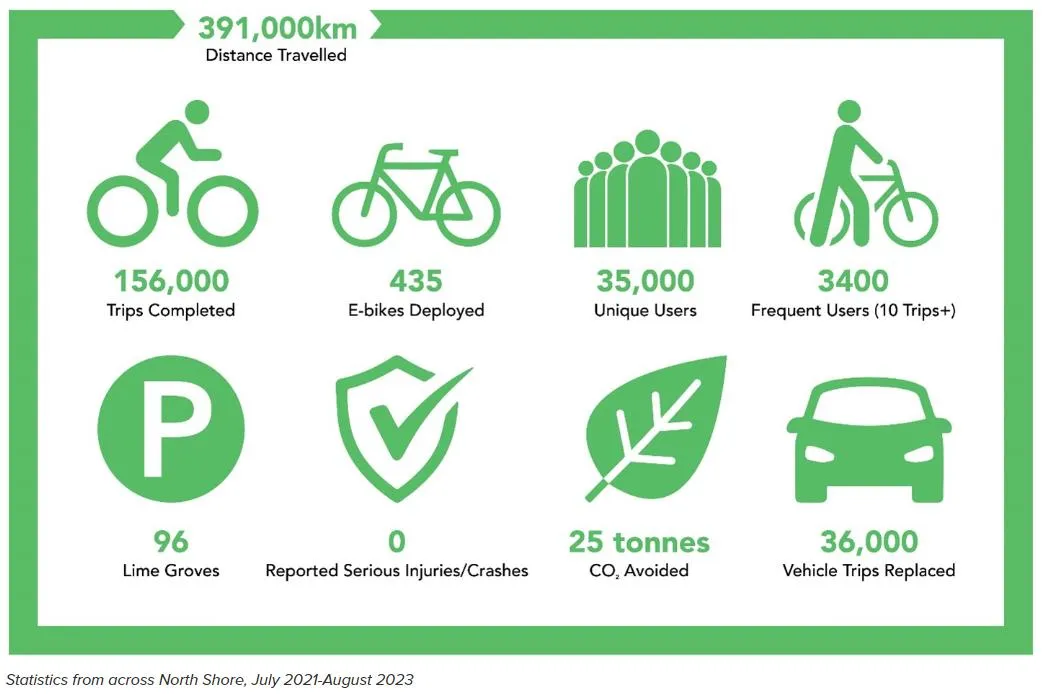
During the first 3-year term of the Provincial Electric Kick Scooter Pilot Project (2021-2024), mainland B.C. municipalities (including but not limited to Kelowna, North Shore, Richmond, Coquitlam, and Vernon) joined the pilot project, went to RFP in search of micromobility service provider(s), and successfully entered into agreement(s) with e-scooter share operator(s). The following statistics (presented in a graphical synopsis from the District of West Vancouver’s website) are “pilot highlights” from the data collected across North Shore from July 2021 to August 2023:

While some past e-scooter/e-bike share pilot projects were deemed successful and resulted in an extension or expansion of operations, staff are aware of pilot projects in other jurisdictions that were deemed unsuccessful and resulted in termination. Staff will take into consideration any available data, established bylaws/policies, and lessons-learned from municipalities, when making future bylaw recommendations to Committee and Council.
COMMENTARY
Micromobility service provider(s) have expressed interest in testing the market in the South Island between 2025 and 2028, aligning with the remainder of the term for the provincial pilot project. Given the favourable climate on southern Vancouver Island (compared to the rest of Canada) and the local governments’ commitments to further multimodal infrastructure throughout the Region, there is reason to believe that a shared micromobility service would be successful here.
App-based micromobility services have evolved to geo-fence designated parking areas with minimal physical infrastructure (also known as parking corrals), that only allows for pick-up and drop-off of those devices in those areas, with the flexibility to adjust those areas based on demand. This means that micromobility devices wouldn’t be parked in places that could obstruct sidewalks or property accesses, for example. Micromobility service providers also have the ability to make private arrangements for parking corrals in key origin-destination points, such as mall parking lots. Based on size and population, Langford can expect up to 60 parking corrals and 300 shared micromobility devices at full build-out.
Rather than going through the lengthy process of establishing a service program and going to RFP to enter into an operating agreement with a single provider, staff recommend that the City establish a permit or licence process by bylaw (similar to our sidewalk use permit bylaw no. 1917 for restaurant patios) that would allow any micromobility service provider to apply to occupy certain areas of the City’s road right-of-way or other City owned lands (such as underutilized portions of sidewalks, boulevards, parking stalls, plazas, parks, etc.) as approved by the appropriate department. The bylaw and permit or licence application process would require a minimum fleet size among other approval requirement and fees comparable to other municipalities to cover administrative costs.
FINANCIAL IMPLICATIONS
There are no financial implications associated with this report.
LEGAL IMPLICATIONS
While not required, if Council wishes to further regulate micromobility devices beyond the provincial regulations for the electric kick scooter pilot project, or incorporate certain aspects to be monitored and enforced (only if necessary) by bylaw enforcement staff (such as helmet wearing), then that can be done in the upcoming omnibus amendments to Langford’s Traffic Bylaw No. 33.
STRATEGIC PLAN ALIGNMENT
4d ǀ Create Awareness and Opportunities for Transportation Mode Shift
Micromobility is supported by Council’s Strategic Plan and aligns with Council’s priorities for climate action and mode-shift to sustainable transportation. Micromobility devices also provide another convenient and more economical option for citizens wishing to make shorter trips within the municipality, or to connect to other modes of transportation, such as public transit.
OPTIONS
Option 1
THAT Council direct staff to prepare a bylaw that allows micromobility service providers to apply for a permit or licence to occupy certain areas of the City’s road right-of-way or other City owned lands with specific approval requirements and a set fee structure.
OR Option 2
THAT Council direct staff as follow:
a. _______________________;
b. _______________________; and
c. _______________________.
SUBMITTED BY
Katelyn Balzer, P.Eng., Director of Engineering and Public Works
Concurrence:
Melisa Miles, Manager of Legislative Services
Concurrence:
Donna Petrie, Senior Manager of Communications & Economic Development
Concurrence:
Yari Nielsen, Director of Parks, Recreation and Facilities
Concurrence:
Matthew Baldwin, RPP, MCIP, Director of Development Services
Concurrence:
Marie Watmough, Director of Legislative & Protective Services
Concurrence: Braden Hutchins, Deputy Chief Administrative Officer (acting CAO)
Document Images
(1)