DocumentsStaff ReportFeb 6, 2024Pages 40–46
Staff Report: Local Government Capacity Funding Grant
Explains recent provincial legislative changes (Bill 44, Bill 46) that require zoning and planning updates and presents options for allocating Langford's Local Government Capacity Funding Grant toward unfunded strategic plans (Parks, Transportation, Active Transportation) to support implementation.
Key facts
- Report date: Monday, February 5, 2024; Department: Planning
- Provincial legislative highlights: Bill 44 (SSMUH requirements, mandatory secondary suites, pro‑active planning framework) and Bill 46 (development finance tools; Amenity Cost Charge)
- Langford's capacity grant amount: $379,457
- Proposed allocation: Parks, Recreation and Trails Master Plan $150,000; Transportation Master Plan $100,000; Active Transportation Plan $135,000 — total $385,000 (shortfall $5,543)
- Key deadlines: Zoning bylaw amendments for SSMUH and secondary suites required prior to June 30, 2024; grant funds must be used by December 31, 2025
Staff Report: Local Government Capacity Funding Grant
DATE: Monday, February 5, 2024
DEPARTMENT: Planning
SUBJECT: Local Government Capacity Funding Grant
Contact
t 250.478.7882
e administration@langford.ca
2nd Floor, 877 Goldstream Avenue
Langford, BC V9B 2X8
Executive Summary
The Province of BC has recently enacted a number of legislative changes intended to expedite housing construction in BC. While staff will prepare a separate report in the near future to discuss the implications and options for Langford, the legislation essentially requires local governments to establish a minimum number of dwelling units per lot in traditional single family residential neighbourhoods, to permit secondary suites in all single-family dwellings, and furthermore to shift their legal planning framework to be more pro-active to housing needs and less reliant on the rezoning process.
The City of Langford was awarded a $379,457 grant from the Province, which can be used either to directly complete the work required by the legislation or to complete projects that will support population growth. As budgets have already been established for much of the mandated work to be addressed in the short term, Council may wish to instead allocate this grant funding to eligible projects that are currently unfunded. Staff recommend that this grant funding be utilized for the Parks, Recreation and Trails Master Plan, the Transportation Master Plan and the Active Transportation Plan, thereby maximizing workplan and public engagement efficiencies, as well as aligning with Council objectives identified in the Strategic Plan and allowing these projects to proceed without the requirement for another City funding source.

Background
On December 7, 2023, the Province of BC enacted a number of legislative changes intended to expedite the construction of more homes throughout BC. These changes are summarized below at a high level.
Bill 44 (Residential Development)
This Bill includes amendments to the Local Government Act that require local governments to make the following changes to their Zoning Bylaws prior to June 30, 2024:
- Small-Scale Multi-Unit Housing (SSMUH): Zoning Bylaws must be amended to allow a minimum of 3-6 dwelling units (depending on lot size and proximity to transit) per residential lot that meets certain criteria (i.e. must be in a Zone restricted to one-or two-family uses, serviced with water and sewer, under 1 acre in lot area, among other criteria).
- Secondary Suites: Zoning Bylaws must be amended to allow secondary suites and/or detached accessory dwelling units in all single-family residential zones.
Staff will bring forward a more detailed report on how these changes affect Langford once additional analysis and mapping work is completed.
In addition, Bill 44 shifts local governments to a “Pro-Active Planning Framework” as follows:
- Housing Needs Reports: Required content and methodology for Housing Needs Reports has been updated to provide a more consistent and robust understanding of local housing needs both currently and over a 20-year time horizon. The Housing Needs Report based on these updated requirements must be completed prior to Jan 1, 2025, and must be updated every 5 years thereafter. (NOTE: staff’s current workplan is to complete this work in 2024, such that the projected housing needs can be incorporated into the OCP Refresh project currently underway)
- Official Community Plans: OCPs must now identify where and how the 20-year housing need as determined by the Housing Needs Report can be accommodated, and must include policies for affordable housing, rental housing and special needs housing. Furthermore, OCPs must now be reviewed every 5 years after the Housing Needs Report is updated to ensure alignment of the two documents. An actual update to the OCP will only be required if it no longer accommodates the new 20-year housing need projection. OCPs must be updated no later than December 31, 2025 to include the new required content. (NOTE: staff’s current workplan is to complete the OCP Refresh project in spring 2025, and this required content will be incorporated at that time)
- Zoning Bylaws: In addition to the immediate Zoning Bylaw updates required to incorporate the SSMUH and Secondary Suite requirements described above, local governments must now review their Zoning Bylaws every 5 years to ensure that the 20-year housing need can be met on pre-zoned land. Rezoning applications, particularly those for larger-scale and higher density development, are still anticipated to occur, however a base level of growth must be permitted. This review must be completed no later than December 31, 2025. (NOTE: staff’s current workplan is to conduct this review after the OCP Refresh is complete, and prior to this legislated deadline)
- Public Hearings: While the legislation does not require the completion of the above work on Housing Needs Reports, OCPs, Zoning Bylaws until 2025, this Bill has established an immediate prohibition on holding Public Hearings for rezoning applications that are predominantly residential and in compliance with the current OCP. This means any rezoning application that meets these criteria and did not receive first reading prior to December 7, 2023 MUST NOT have a public hearing.
There are three categories of rezoning applications moving forward:
- Predominantly residential and OCP compliant applications: Public Hearing not permitted.
- Non-residential (i.e. commercial, industrial, institutional) or predominantly non-residential and OCP compliant: Public Hearing optional.
- OCP amendment required: Public Hearing required.
While the legislation is clear on #1 and #3, Council has some flexibility with how to treat rezoning applications falling into #2 (an example of this is the current rezoning application to amend the CD3 (Westhills) Zone to allow a larger daycare in the Plexxis building in the Westhills core). A separate staff report will be drafted in order that Council can consider the options available to them in more detail.
Bill 47 (Transit-Oriented Areas)
Some local governments (including Langford) are required to adopt a bylaw prior to June 30, 2024 to establish Transit Oriented Areas around specified transit exchanges. In the case of Langford, the bylaw must establish minimum permitted heights/densities around the Langford Exchange on Station Ave and must remove any requirement for a new development proposal in that area (i.e. a project not currently zoned) to provide a minimum number of off-street parking spaces for residential uses (accessible parking and parking for non-residential uses can still be required).
Unlike the SSMUH regulations, any development application within the Transit Oriented Area is still subject to rezoning; however, applications meeting the height/density criteria may not be rejected on the basis of that height or density. As above, staff will prepare a more detailed report on how these changes affect Langford once some additional analysis and mapping work is completed.
Bill 46 (Development Finance Tools)
Also included in the collection of legislation changes are changes to the types of Development Cost Charges (DCCs) that can be collected by local governments, and the introduction of a new Amenity Cost Charge (ACC) tool. Council can consider applying any of the new DCC powers if/when any projects relating to the new infrastructure categories arise (i.e. fire halls, police facilities, solid waste facilities).
The new ACC tool is intended to provide a standardized and transparent method of collecting funds for the community amenities needed to support growing populations. Langford’s Amenity Contribution Policy is a less formal version of this. While many other municipalities negotiate amenity contributions on a case-by-case basis, the current Amenity Policy does provide that clear expectation to the development community; however, it is applied and secured at the time of rezoning as a bonus for increased density. With the legislated planning framework shifting to be more pro-active with the intent of allowing more development through pre-zoning vs. individual rezoning applications, the Amenity Contribution Policy will be less effective. Similar to DCCs, a new ACC bylaw would trigger the payment of specified amenity contributions at the time of Building Permit or Subdivision approval and would not rely upon the rezoning process in order to be secured and payable. As this is an optional tool available to local governments, there isn’t the same urgency to move this workplan forward as the other bodies of work included in the legislation. As per Council’s Strategic Plan, staff will research the options further and prepare a report for Council’s consideration by the end of 2024.
Local Government Capacity Funding Grant
Acknowledging the significant amount of staff time and resources required to complete all of this legislated work, the Province announced that they would be providing $51 million in grant-based funding to local governments. The amount awarded to each municipality includes a flat funding amount as well as an additional per-capita amount. Langford’s portion of this grant funding is $379,457.
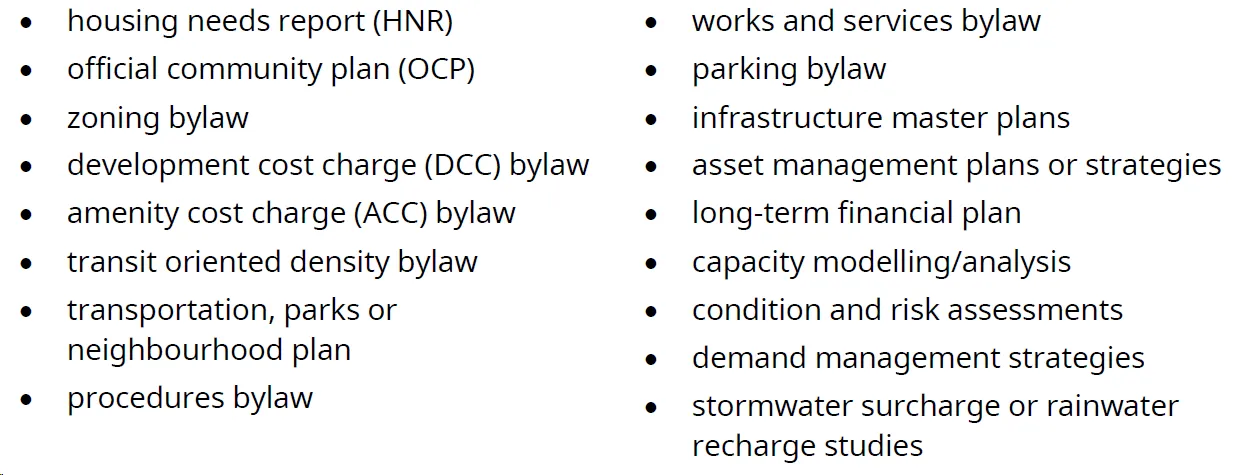
The Province recently released guidelines to provide additional detail with respect to the eligible use of these funds. The eligible project list is quite extensive, and includes the obvious projects directly related to implementing the legislation as well as a number of other plans, studies and assessments that will support population growth.
Commentary
While the proposed 2024-2028 Financial Plan has yet to receive consideration and approval by Council, staff note that the 2023-2027 Financial Plan already includes approved funding for the OCP Refresh project as well as Zoning Bylaw Updates and a general consulting budget. As such, staff already have pre-approved funding in place for the OCP Refresh project, the Housing Needs Report, and the body of work that must be completed by June 30, 2024.
Council’s Strategic Plan identifies a number of new projects not accounted for in the 2023-2027 Financial Plan that are intended to commence this year. Rather than allocating this grant funding to work that is already accommodated by the current Financial Plan, Council may wish to instead approve staff to allocate these funds towards new, unfunded or partially funded eligible projects, allowing staff to start work in advance of full budget approval. In order to maximize efficiencies in resources and to allow for a coordinated public engagement strategy over multiple projects, Council may wish to direct the grant funds be used towards the Parks, Recreation and Trails Master Plan, the Transportation Master Plan and Active Transportation Plan.
Financial Implications
Staff anticipate that the following budgets will be required for these projects:
| Project | Budget |
|---|---|
| Parks, Recreation and Trails Master Plan | $150,000 |
| Transportation Master Plan | $100,000 |
| Active Transportation Plan | $135,000 |
| Total | $385,000 |
This amounts to a total of $385,000. As such, the grant would cover all but $5,543 of the anticipated cost of these three projects.
Providing approval to allocate the grant funding to these projects in advance of the full approval of the 2024-2028 Financial Plan will allow staff to commence work, to prepare requests for proposals for any required consulting work, and to award contracts such that these workplans can be advanced more quickly and be better coordinated with the OCP Refresh project.
Furthermore, allocating grant funding to these three unfunded projects reduces pressure on the Budget process, as funds would no longer need to be allocated from taxation and/or surplus.
The Grant funding has been received by the City and must be used prior to December 31, 2025. This timing works well for the three identified projects, as they are all intended to commence this year and complete by Q3 2025.
Legal Implications
None.
Strategic Plan Initiatives
The various bodies of work described in this report are included in Council’s Strategic Plan as follows:
- 1a: Refresh the Official Community Plan
- 1k: Update the Housing Needs Report
- 1o: Update the Zoning Bylaw to Reflect the New Small-Scale Multi-Unit Housing and Transit-Oriented Development Legislation
- 1p: Review the Zoning Bylaw to Ensure Alignment with the Housing Needs Report and OCP
- 4a: Develop a Transportation Master Plan
- 4b: Develop an Active Transportation Plan
- 6b: Development a Parks, Recreation and Trails Master Plan
Leveraging the grant funding to advance the unfunded or partially funded projects that have strategic value to commence prior to full budget approval will accelerate Council’s goals and maximize the efficiencies that can be generated through coordinating the workplans for these projects.
Options
Option 1
THAT Council direct staff to allocate the Local Government Capacity Funding Grant to the Transportation Master Plan, the Active Transportation Plan, and the Parks, Recreation and Trails Master Plan.
OR Option 2
THAT Council direct staff to allocate the Local Government Capacity Funding Grant to the following projects ________________.
SUBMITTED BY: Leah Stohmann, MCIP RPP, Deputy Director of Planning and Subdivision
Concurrence:
Donna Petrie, Senior Manager of Communications & Economic Development
Concurrence:
Yari Nielsen, Director of Parks, Recreation and Facilities
Concurrence:
Matthew Baldwin, MCIP, RPP, Director of Planning and Subdivision
Concurrence:
Katelyn Balzer, P.Eng., Director of Engineering and Public Works
Concurrence:
Michael Dillabaugh, CPA, CA, Director of Finance
Concurrence:
Marie Watmough, Deputy Director of Corporate Services
Concurrence: Braden Hutchins, Director of Corporate Services
Concurrence:
Darren Kiedyk, Chief Administrative Officer