DocumentsStaff ReportMay 9, 2024Pages 3–8
Staff Report: Bylaw No. 2160 — Establishing Transit-Oriented Areas
Staff report recommending the City adopt Bylaw No. 2160 to designate a Transit-Oriented Area (TOA) around the Langford Bus Exchange in order to implement provincially prescribed minimum heights and densities and to address off-street residential parking requirements.
Key facts
- Report date: Monday, May 6, 2024
- Deadline to adopt TOA by bylaw: on or before June 30, 2024
- TOA radius: 400 metres from a specified coordinate at the Langford Bus Exchange (Station Ave); Tier 4 = 0–200m, Tier 5 = 200–400m
- Prescribed minimums: Tier 4 minimum density 3.5 FAR (min height 10 storeys); Tier 5 minimum density 2.5 FAR (min height 6 storeys)
- Council options regarding elimination of minimum residential off-street parking: eliminate for all TOA properties or only for lands rezoned after December 7, 2023
Staff Report to Special Council
t 250.478.7882
e administration@langford.ca
2nd Floor, 877 Goldstream Avenue
Langford, BC V9B 2X8
DATE: Monday, May 6, 2024
DEPARTMENT: Planning
APPLICATION NO.: Z23-0029
SUBJECT: Bylaw No. 2160: Establishing Transit-Oriented Areas
EXECUTIVE SUMMARY
The Province of British Columbia has made amendments to the Local Government Act to enable transit-supportive densities adjacent to specified transit stations. These areas are referred to as Transit-Oriented Areas (TOAs) in the new legislation, and are intended to be areas of higher density, mixed-use development in the proximity of transit stations in order to promote mode shift and the creation of complete communities.
Through this legislation, the Provincial Government designated a list of transit stations, including Langford Bus Exchange on Station Avenue, along with minimum prescribed densities and heights within certain distances of the station. Local governments are required to designate all TOAs for the specified transit stations by bylaw and amend their Zoning Bylaw to eliminate minimum residential off-street parking requirements for these TOAs on or before June 30, 2024.
COMMENTARY
Density and Height Requirements
In December 2023, the Province of British Columbia made amendments to the Local Government Act (LGA) that enables the Province to require local governments to adopt bylaws that:
- designate residentially zoned lands within certain distances of specified transit stations as Transit-Oriented Areas (TOAs);
- establish the minimum prescribed height and density set out by the TOA Regulation for lands within the TOA; and
- eliminate minimum residential off-street parking requirements for new development in the TOA.
Local governments are required to adopt the TOA bylaw on or before June 30, 2024.
The Transit-Oriented Areas Regulation (the Regulation) establishes the distances that must be utilized to define the TOA associated with different types of transit stations (i.e. bus exchanges, Sky Train stations and West Coast Express stations) as well as the different minimum height and density regulations that apply within the TOA.
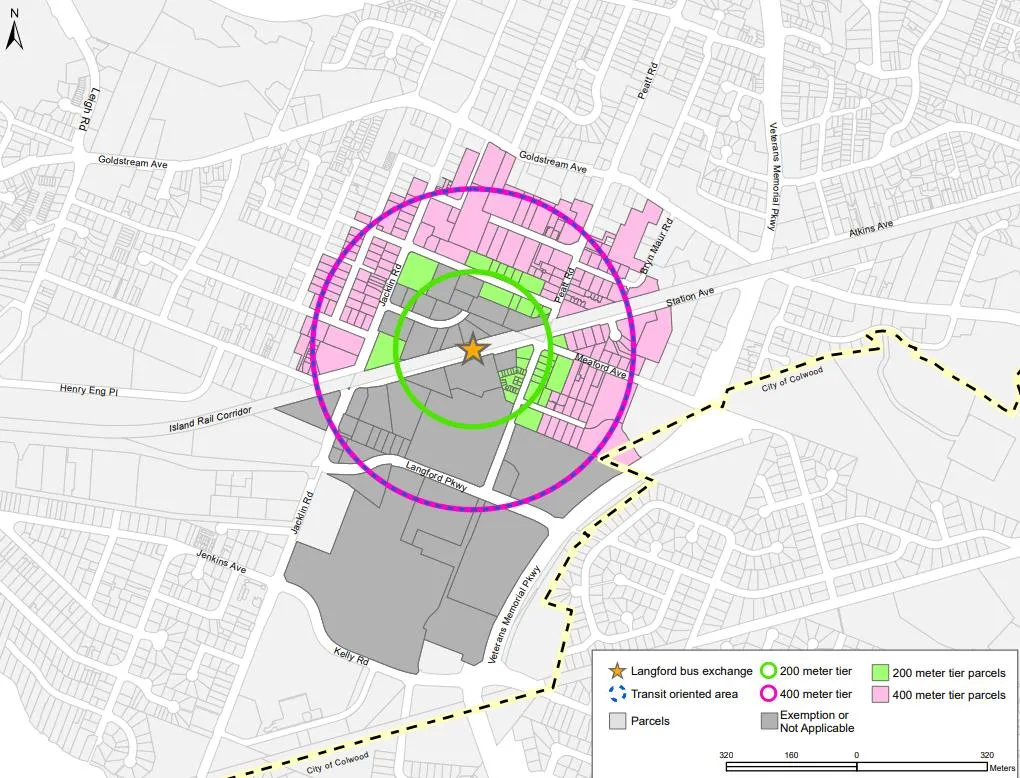
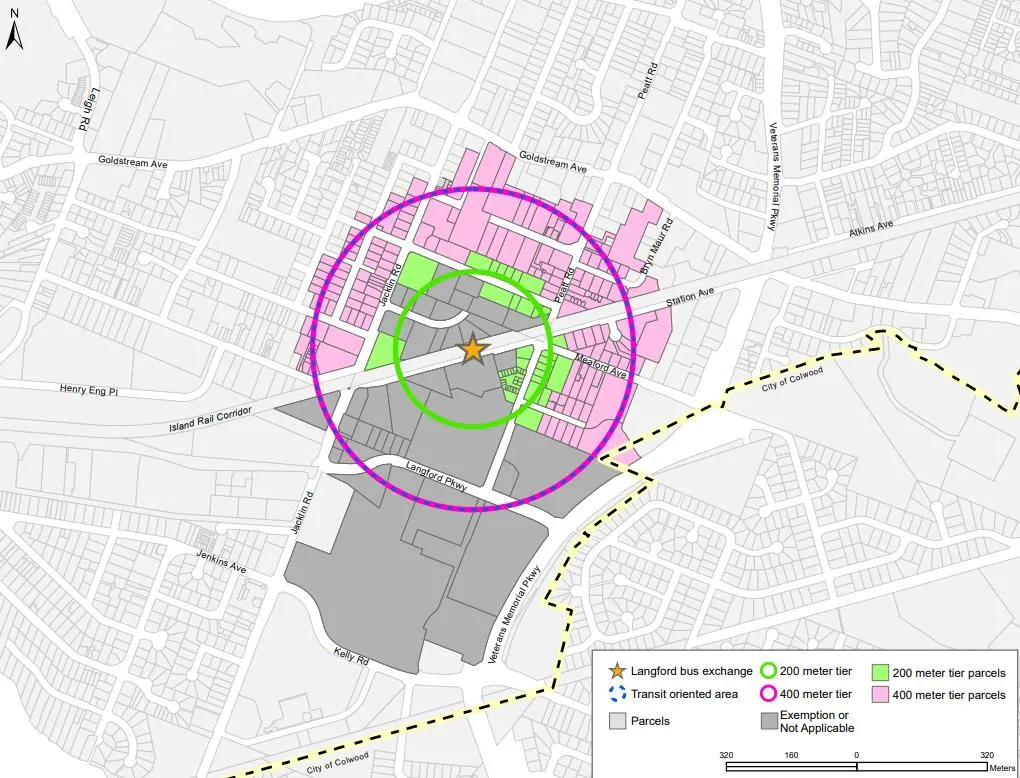
The Province has identified the City’s TOA as the area within a 400 metre radius (approximately a 5-minute walk) of a specified coordinate within the Langford Bus Exchange on Station Avenue. This TOA is then broken into two tiers, which establish the location of the applicable minimum densities. Pursuant to the Regulation, the City’s TOA is subject to Tiers 4 and 5, with the requirements of Tier 4 applicable within 200m of the coordinates, and Tier 5 applicable 200-400m from the coordinates. Table 1 below outlines these prescribed distances, as well as the associated minimum allowable height and minimum allowable density.
Table 1 – City of Langford: Transit-Oriented Area Requirement
| TOA Type | Tier | Prescribed Distance | Minimum Allowable Density (FAR/FSR) | Minimum Allowable Height (Storeys) |
|---|---|---|---|---|
| Bus | 4 | 0 – 200m | 3.5 | 10 |
| Bus | 5 | 200 – 400m | 2.5 | 6 |
Figure 1 below identifies the properties that fall within Tiers 4 (shaded green) and 5 (shaded pink). The properties shaded dark grey are exempt from the TOA as they are currently zoned commercial or industrial, and the legislation applies to lands zoned to permit residential uses.

It is important to note that the TOA Bylaw does not pre-zone land, but rather defines the minimum height and density provisions that must be accommodated by the local government when rezoning land. While the Regulation refers to the density and height provisions as “minimums”, it is further explained that this term is used to reference the local government’s ability to apply their discretion to reject a rezoning application for a property within the TOA, and not as a minimum expectation for all new development within the TOA.
Essentially, a local government must not reject a rezoning application on the basis of the proposed density and/or height if the application is within the minimums described in Table 1. The local government may approve a rezoning application for a project that exceeds the minimum height and density in Table 1, and may approve a rezoning application for a project that is less than the minimum height or density in Table 1, provided that the Zone does not limit the height or density to that lesser amount. In other words, when rezoning land with the TOA, the Zone must accommodate at least the minimum height and density specified by the Regulation, even if an individual project does not utilize the full allowance.
While it was not initially clear in the implementation manual provided by the Province, they have recently clarified that local governments can apply conditions of rezoning, including density bonussing provisions, as part of their rezoning approval process for lands within the TOA. This allows Council to continue to apply the Amenity Contribution Policy, the Low Carbon Concrete Policy, and other conditions of approval as appropriate.
Off-Street Parking Requirements
In addition, the legislation prohibits local governments from requiring off-street residential parking spaces within TOAs (with the exception of accessible parking) and, as with the TOA Bylaw, requires the local governments to update their Zoning Bylaw to reflect this by June 30, 2024. The legislation does not preclude a developer from including residential parking in the building if they so choose and allows local governments to apply design standards (such as minimum parking space dimensions, EV charging, etc.) should developers choose to include off-street residential parking in their proposals. Local governments may still apply requirements for off-street commercial parking, loading/unloading, car-share, and bicycle parking.
As the TOA includes lands that have already been rezoned but not yet built, Council has some discretion as to how they wish to apply this off-street residential parking exemption. Strictly as per the legislation, the prohibition on requiring off-street residential parking only applies to lands that had not been rezoned for development as of December 7, 2023. As such, Council could direct staff to either word this amendment to Zoning Bylaw No. 300 to eliminate all off-street residential parking for properties within the TOA OR to eliminate the requirement for off-street residential parking on lands rezoned after December 7, 2023.
FINANCIAL IMPLICATIONS
There are no known financial implications associated with this report.
LEGAL IMPLICATIONS
As noted, the legislation states that there is no requirement to pre-zone to the minimum prescribed heights and densities applicable in the TOA. Application fees, submission requirements, staff reports, bylaw readings, and adoption are not affected by the legislation or regulation. The City reserves the right to approve a higher density and/or height than the Provincial density requirements.
In the short term, the new legislation provides temporary relief from the requirement that Zoning Bylaws be consistent with Official Community Plans (OCPs), as these changes do not need to be reflected in OCPs until December 31, 2025. Staff are currently working on the OCP Refresh Project identified in Council’s 2023-2027 Strategic Plan and will incorporate the TOA into the OCP as part of this work which has an anticipated completion timeline of Spring 2025.
Should local governments not comply with the legislative requirements by the deadline of June 30, 2024, the Province may introduce regulations that designate the TOAs in their municipality.
Langford staff recently discussed the proposed TOA map and corresponding bylaws with Provincial Staff and confirmed it complies with the Transit-Oriented Areas legislation.
STRATEGIC PLAN INITIATIVES
1o – Update the zoning bylaw to reflect the new small-scale, multi-unit housing and transit-oriented development legislation.
OPTIONS
Option 1
THAT Council:
- Proceed with consideration of Bylaw No. 2160 as drafted;
AND
- Direct staff to draft Bylaw No. 2155 to amend Zoning Bylaw No. 300 to eliminate off-street residential parking for all properties within the Transit-Oriented Area.
Option 2
THAT the Committee of the Whole recommend that Council:
- Proceed with consideration of Bylaw No. 2160 as drafted;
AND
- Direct staff to draft Bylaw No. 2155 to amend Zoning Bylaw No. 300 to eliminate off-street residential parking within the Transit-Oriented Area on properties rezoned after December 7, 2023, in accordance with the Transit-Oriented Areas Provincial legislation.
SUBMITTED BY
Matt Notley, Planner II, Community Planning and Climate Change
Concurrence:
Leah Stohmann, RPP, MCIP, Director of Community Planning and Climate Change
Concurrence:
Donna Petrie, Senior Manager of Communications & Economic Development
Concurrence:
Yari Nielsen, Director of Parks, Recreation and Facilities
Concurrence:
Matthew Baldwin, RPP, MCIP, Director of Development Services
Concurrence:
Katelyn Balzer, P.Eng., Director of Engineering and Public Works
Concurrence:
Michael Dillabaugh, CPA, CA, Director of Finance
Concurrence:
Marie Watmough, Director of Legislation and Protective Services
Concurrence: Braden Hutchins, Deputy Chief Administrative Officer
Concurrence:
Darren Kiedyk, Chief Administrative Officer
Attachment(s): Bylaw No. 2160
Appendix A – Transit-Oriented Areas Map